


Executive Summary
Guyana has transformed into one of the fastest-growing oil and gas markets in the world. Production reached over 600,000 barrels per day in 2024, with projections exceeding 1.2 million barrels daily by 2027. More than $55 billion in upstream investments have been committed, and thousands of jobs have been created across operations, engineering, and support functions.
This rapid expansion creates operational strain that extends far beyond drilling rigs and production platforms. Finance teams manage increasingly complex cost accounting across joint ventures. HR departments process payroll and compliance for growing workforces across multiple contractors. Procurement teams navigate new supplier networks while meeting local content requirements. Data management becomes critical as regulatory reporting intensifies.
Boutique, Guyanese-owned outsourcing partners offer a strategic response to these pressures. They provide scalable back-office support while aligning with Guyana’s Local Content framework, delivering operational efficiency without compromising regulatory compliance or local economic development goals.
Guyana’s Oil & Gas Growth Is Creating Operational Strain Beyond the Field
The scale of Guyana’s energy boom is unprecedented for a nation of approximately 800,000 people. ExxonMobil’s operations offshore continue to expand, with multiple FPSOs now in production and additional vessels planned. Other operators are advancing projects, and the supply chain ecosystem is maturing rapidly.
This growth creates immediate pressure on internal support functions. Finance teams must handle multi-currency transactions, complex joint venture accounting, and stringent audit requirements. HR departments face the challenge of recruiting, onboarding, and managing compliance for workforces that can scale rapidly based on project timelines. Procurement teams must balance cost efficiency with local content obligations while maintaining quality standards.
Compliance and reporting requirements intensify as operations mature. The Guyana Revenue Authority, the Ministry of Natural Resources, and other regulatory bodies require detailed documentation. Environmental, social, and governance reporting standards continue to rise. Data management becomes more complex as operations generate increasing volumes of operational, financial, and regulatory information.
These administrative demands can distract leadership from strategic priorities. Country managers and operations directors find themselves managing routine processes instead of focusing on project execution, stakeholder relationships, and long-term planning. The risk of administrative errors increases as internal teams stretch to meet growing demands.
Outsourcing Is Common in Oil & Gas, But Scale Is Not Always the Answer
Global oil and gas companies have long relied on outsourced business process services. Large multinational BPO providers handle payroll, accounts payable, HR administration, and data entry for major operators worldwide. These arrangements typically deliver cost savings through standardization and offshore labor arbitrage.
However, the global BPO model does not always align with the realities of operating in Guyana. Time zone differences can create communication delays when urgent issues arise. Standardized processes designed for mature markets may not accommodate Guyana’s specific regulatory requirements or business practices. Decision-making hierarchies within large BPO organizations can slow responses when flexibility is needed.
Guyana’s Local Content legislation adds another dimension. The framework requires that Guyanese nationals and Guyanese-owned businesses receive preference in procurement and employment decisions. Companies operating in the sector must demonstrate measurable progress toward local content targets. Outsourcing to global providers located outside Guyana may not contribute to these objectives, and in some cases may create additional compliance complexity.
The Strategic Advantage of Boutique, Guyanese-Owned Outsourcing
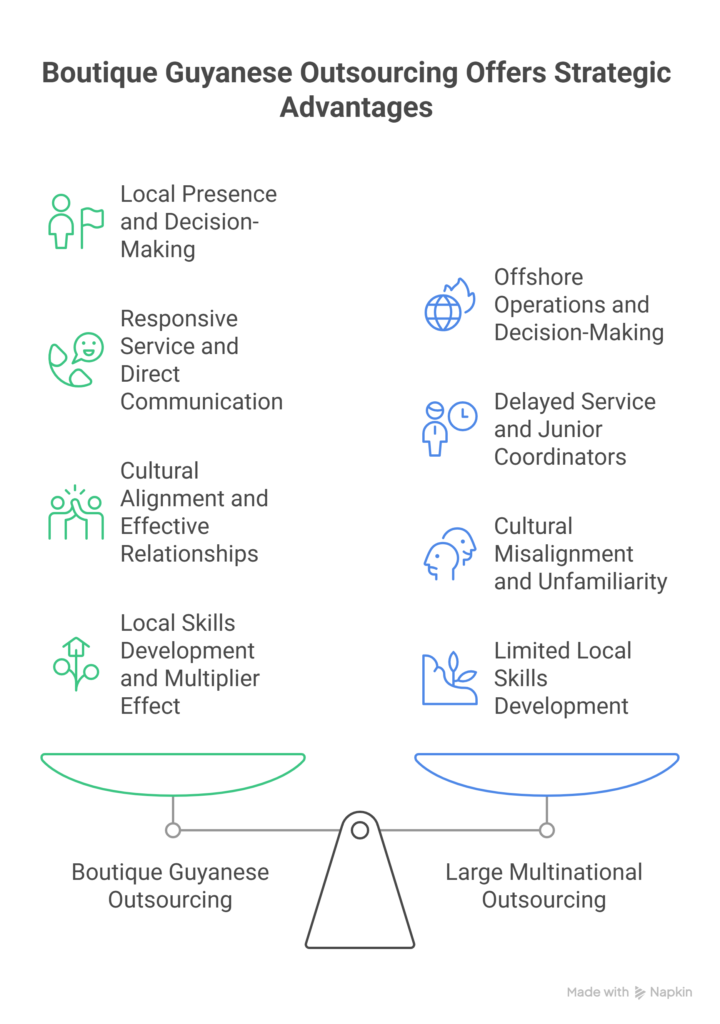
Boutique, Guyanese-owned outsourcing providers operate with different characteristics than large multinational firms. They maintain local presence and decision-making authority. Leadership teams understand Guyana’s regulatory environment, business culture, and operational realities. They can adapt processes quickly as client needs evolve or regulations change.
Proximity enables more responsive service. When issues arise, resolution happens within the same time zone and often through direct communication with senior management. Client relationships tend to be more hands-on, with account management handled by owners or senior leaders rather than junior account coordinators.
Cultural alignment matters in service delivery. Guyanese professionals understand the local business environment, communication styles, and professional norms. They navigate relationships with government agencies, suppliers, and stakeholders more effectively than offshore teams unfamiliar with the market.
These providers also contribute directly to local skills development. They employ Guyanese nationals and invest in training programs that build technical and professional capabilities. This creates a multiplier effect as employees develop skills that benefit the broader economy.
Aligning Outsourcing With Guyana’s Local Content Objectives
Guyana’s Local Content legislation establishes clear priorities for the oil and gas sector. Companies must employ Guyanese nationals wherever possible and provide training and development opportunities. They must give preference to Guyanese-owned businesses in procurement decisions. The legislation aims to retain economic value within Guyana and build long-term local capacity.
Outsourcing to Guyanese-owned providers directly supports these objectives. Employment of local professionals counts toward local content targets. Contracts with Guyanese businesses strengthen procurement compliance. Revenue generated stays within the local economy rather than being repatriated to offshore BPO centers.
This alignment creates strategic value beyond cost savings. It reduces regulatory risk by demonstrating tangible commitment to local content requirements. It strengthens relationships with government stakeholders and local communities. It positions companies as responsible operators invested in Guyana’s long-term development.
Companies face regular reporting requirements under the Local Content framework. Working with Guyanese-owned outsourcing partners simplifies this reporting by providing clear documentation of local business engagement and employment. It reduces the administrative burden of tracking and reporting these metrics across multiple vendors.
Industry-Specific Improvements Enabled by Local Outsourcing
Upstream Operations
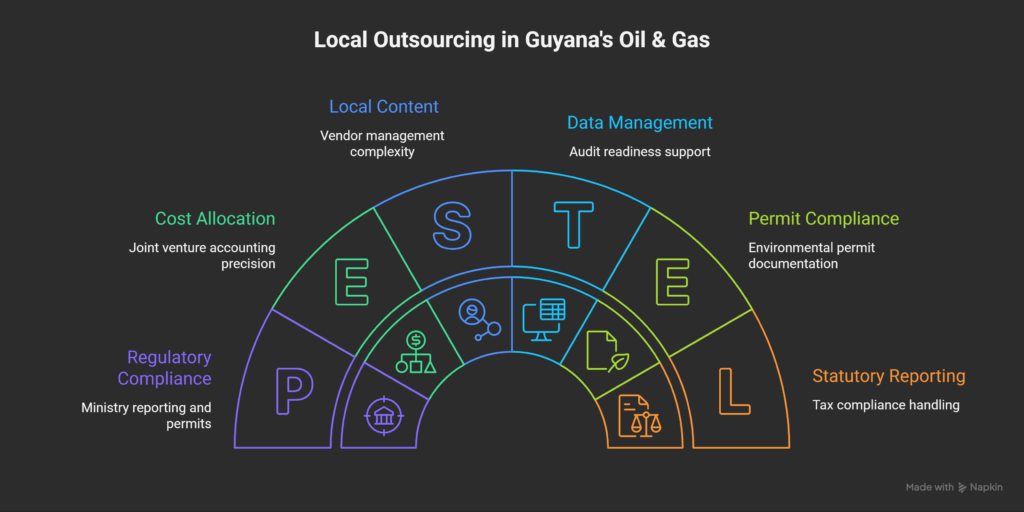
Operators managing exploration, development, and production face complex back-office demands. Joint venture accounting requires precise cost allocation across multiple partners. Regulatory reporting to the Ministry of Natural Resources and other agencies demands accuracy and timeliness. Vendor management becomes more complex as local supply chains develop.
Local outsourcing providers can handle accounts payable processing, ensuring vendors are paid accurately and on time while maintaining proper documentation. They manage payroll administration for local staff, handling tax compliance and statutory reporting. They provide data entry and document management services that support audit readiness and regulatory compliance.
The result is reduced administrative burden on country leadership, improved accuracy in financial reporting, and stronger compliance posture.
Midstream Operations
Companies developing pipeline infrastructure, storage facilities, and logistics operations require robust support for project management documentation, procurement tracking, and compliance reporting. These projects often involve multiple contractors and complex interfaces with regulatory authorities.
Outsourcing partners can manage contract administration, tracking deliverables and milestones across multiple vendors. They handle compliance documentation for environmental permits, land use agreements, and construction approvals. They provide invoice processing and reconciliation services that keep projects on budget.
This support enables project teams to focus on execution while maintaining confidence in administrative accuracy and regulatory compliance.
Oilfield and Professional Services Companies
Service companies providing drilling, engineering, logistics, and technical support face their own operational challenges. They must manage mobilization and demobilization of personnel, often on short timelines. They handle complex timesheet management across multiple client sites. They maintain detailed records for safety compliance and quality assurance.
Local outsourcing providers can process timesheets and manage payroll for field personnel, ensuring accurate and timely payment. They handle onboarding documentation and compliance tracking for rotating workforces. They provide administrative support for proposal development and client reporting.
These services allow service companies to scale operations efficiently while maintaining the administrative rigor that clients expect.
Why Local Presence Matters in a High-Growth Energy Market
Time zone alignment eliminates delays that can occur when working with offshore service providers. When a payroll issue arises on a Thursday afternoon in Georgetown, local teams can resolve it before the workday ends rather than waiting for offshore teams to begin their workday.
Communication becomes more effective when teams operate in the same environment. Local providers understand context without lengthy explanations. They recognize when regulatory guidance changes or when industry practices evolve. They can attend in-person meetings when necessary and build relationships that strengthen service delivery.
Understanding Guyana’s business environment creates practical advantages. Local providers know how government agencies operate, which documentation they require, and how to navigate bureaucratic processes efficiently. They understand payment practices, banking systems, and business customs that affect day-to-day operations.
Outsourcing as Risk and Reputation Management
Compliance failures in the oil and gas sector carry significant consequences. Regulatory penalties can be substantial. Reputational damage can affect stakeholder relationships and create operational complications. Administrative errors in payroll or benefits can create employee relations issues that distract from operational priorities.
Local outsourcing providers contribute to risk management through process discipline and documentation rigor. They maintain audit trails that support regulatory inspections and internal audits. They implement controls that reduce the risk of payroll errors, benefits miscalculations, or tax compliance failures. They manage documentation systems that ensure information is accessible when regulators or auditors request it.
Reputation management extends beyond compliance. Companies that demonstrate meaningful commitment to local content through their outsourcing decisions build stronger relationships with government stakeholders and civil society. They position themselves as responsible operators invested in Guyana’s development.
This reputational value matters in a high-visibility sector where public perception affects license to operate. Boutique providers like Express International offer examples of how local outsourcing can strengthen both operational performance and community relationships.
Final Takeaway for Energy Leaders
Guyana’s oil and gas sector will continue expanding for the foreseeable future. Companies that manage this growth effectively will balance operational excellence with regulatory compliance and stakeholder relationship management.
Outsourcing back-office functions to boutique, Guyanese-owned providers offers a strategic approach to scaling operations. It delivers cost efficiency and operational flexibility while aligning with local content requirements. It reduces administrative burden on leadership teams while building local capacity and contributing to Guyana’s economic development.
The choice is not between managing everything internally or outsourcing to large global providers. A third option exists that combines professional service delivery with local presence, regulatory alignment, and community impact. For energy companies committed to long-term success in Guyana, this approach represents responsible scaling that balances business objectives with broader stakeholder interests.
About Express International
Express International is a 100% Guyanese-owned business process outsourcing company providing finance, HR, data management, and compliance support services to companies operating in Guyana and across North America. Recognized among the top 500 BPO providers globally, Express International serves clients in energy, transportation, healthcare, and financial services with professional back-office solutions delivered from Georgetown, Guyana.