

At a Glance
What if you could reduce back-office workload by over 40% while improving accuracy and response times?
AI is transforming trucking-but automation alone isn’t closing the gap. From billing disputes to real-time coordination, logistics still runs on human judgment.
The companies gaining ground aren’t choosing between technology and people. They’re combining both: AI for speed, and nearshore teams for execution.
In this post, we break down exactly where AI falls short-and how a hybrid workforce model helps trucking companies scale smarter, cut costs, and stay competitive.
Every trucking company is hearing the same pitch right now: automate everything, cut costs, scale fast. And AI does have a real role to play. Route optimization, invoice processing, document extraction-these are genuine wins.
But if you’ve been in operations long enough, you know what happens when leadership implements a technology solution and calls it done. Exceptions pile up. Communication breaks. And your people end up managing the gaps that the software was supposed to eliminate.
The smartest logistics operators aren’t going all-in on AI. They’re building hybrid teams-combining automation with nearshore back-office support-and the results are measurable.
AI in Trucking Operations Is Growing Fast-For Good Reason
The pressure on trucking companies is real: rising per-mile costs, tighter margins, and customers expecting real-time visibility. So when AI offers a way to process more data, faster, for less-operators are paying attention.
McKinsey & Company reports that AI adoption in supply chain operations can reduce logistics costs by up to 15% while improving forecasting accuracy by as much as 50%. PwC data shows that over half of operations leaders are already investing in AI to drive efficiency.
In logistics specifically, AI is being deployed across:
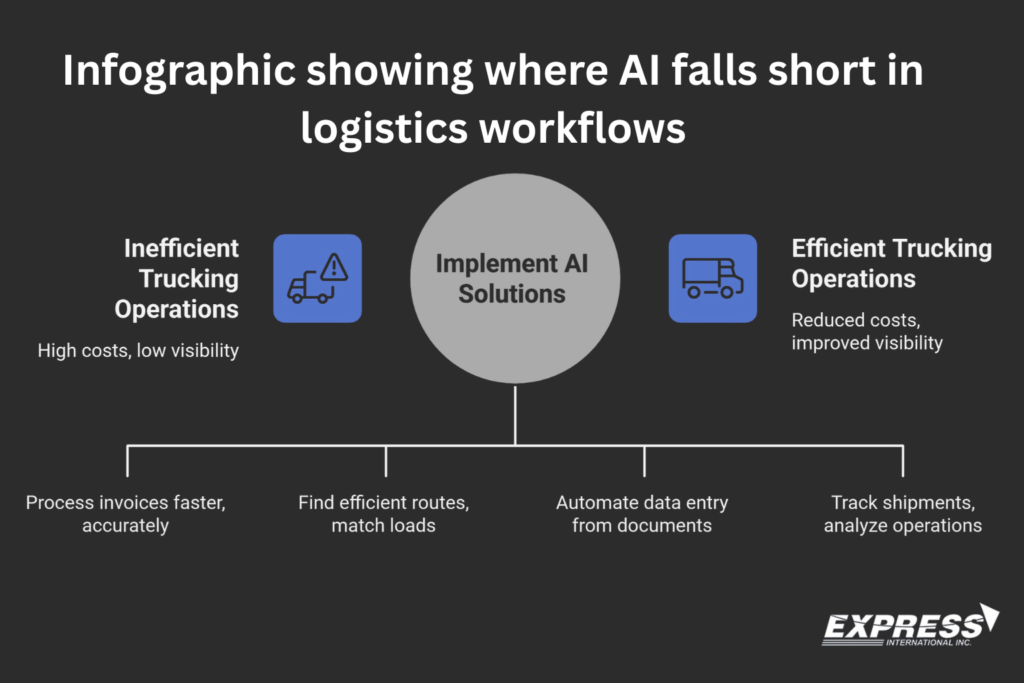
- Freight billing and invoice processing
- Route optimization and load matching
- Document extraction and data entry
- Real-time shipment visibility and operational analytics
For high-volume, standardized workflows, this level of automation is a genuine competitive advantage. No argument there.
But there’s a gap between what AI can automate and what trucking operations actually require-and that gap is where companies are losing time, money, and client trust.
The Reality: AI Still Can’t Handle Operational Complexity
According to Gartner, the majority of supply chain decisions still require human involvement-especially in exception-heavy environments like trucking.
Here’s where automation consistently falls short:
1. Exception Handling
AI can process standard workflows at scale. But trucking is rarely standard. Rate discrepancies, missing PODs, last-minute load changes, carrier no-shows-these situations require judgment, context, and the ability to make calls in real time. AI flags the problem. It can’t resolve it.
2. Communication and Coordination
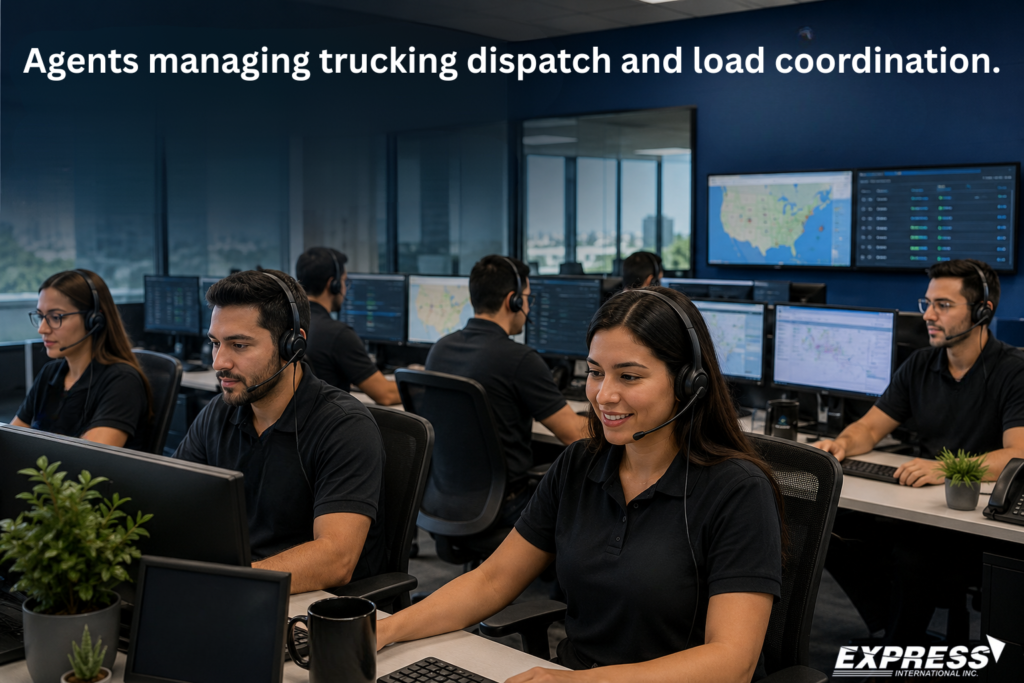
The trucking industry runs on relationships: brokers, drivers, shippers, receivers. When something goes wrong-and it will-what customers need is a person on the line who understands the situation, can make decisions, and will follow through. AI can assist with communication workflows, but it cannot replace the human accountability that keeps clients from churning.
3. Accuracy and Compliance
A missed field in a load tender or a billing error on a fuel surcharge can cascade into payment delays, disputes, and lost revenue. AI extracts and processes data-but it takes trained human eyes to catch what doesn’t look right and ensure submissions are complete and compliant.
4. Turning Insights Into Action
AI dashboards generate excellent data. But data doesn’t dispatch a driver or call a customer to manage a late delivery. Execution still requires people-people who understand the business, the client relationships, and the urgency of logistics timelines.
Technology supports operations. People ensure execution. The strongest trucking back offices run on both.
The Smarter Model: AI + Nearshore BPO
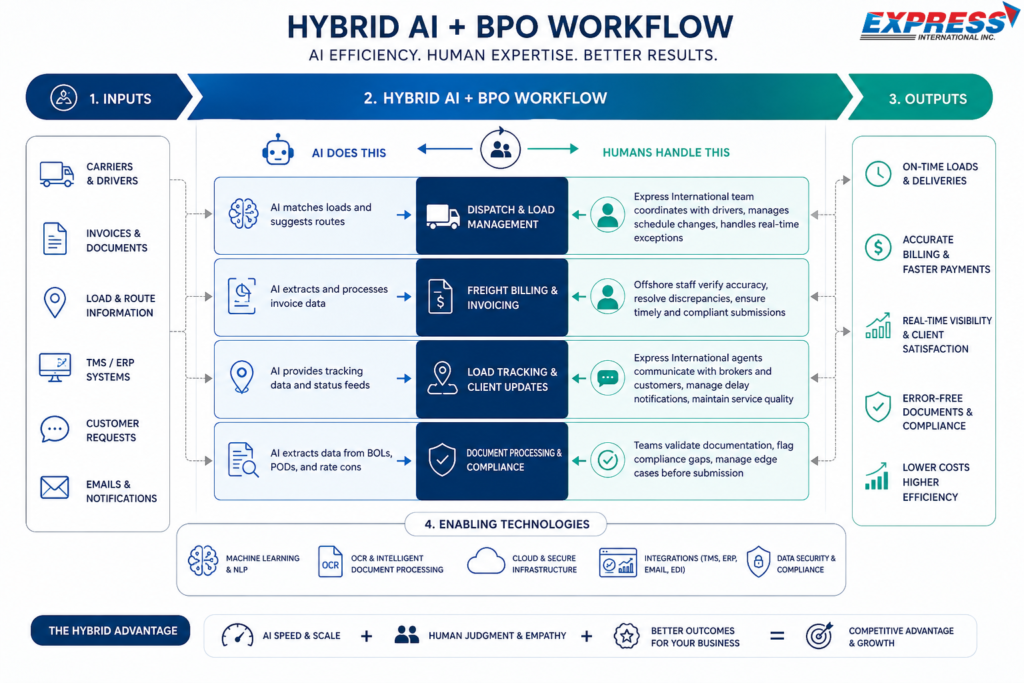
To close the gap that automation creates, leading logistics companies are adopting a hybrid workforce model-combining AI tools with dedicated nearshore support teams who manage the work that requires human judgment.
This isn’t a workaround. It’s a deliberate operating strategy that allows businesses to:
- Automate repetitive, high-volume tasks at speed and scale
- Maintain human oversight on exceptions, compliance, and client-facing communication
- Improve accuracy without adding domestic headcount overhead
- Scale support capacity in line with freight volume-without the hiring lag
The economics also hold up. Nearshore BPO from Guyana typically delivers cost structures significantly below equivalent U.S. roles, while maintaining the cultural alignment, English fluency, and time zone overlap that make the model operationally seamless.
AI handles the speed. Nearshore teams handle the complexity.
Why Guyana Is the Right Location for Trucking Back-Office Support
With U.S. operational costs under sustained pressure-ATRI data shows total marginal costs per mile have risen sharply in recent years-trucking companies are looking hard at outsourcing as a cost lever. But not all outsourcing delivers.
Guyana stands out for specific structural reasons:
- Native English speakers: Unlike many offshore markets, Guyana’s workforce communicates in English as a first language. No heavy accents to navigate, no translation delays, no miscommunication on time-sensitive loads.
- U.S. time zone alignment: Georgetown operates within Eastern time zone range, meaning your outsourced team works the same hours your clients and carriers do. Real-time coverage without overnight shifts.
- Cultural compatibility: Guyanese professionals are culturally close to North American workplace norms-in communication style, accountability expectations, and customer service standards.
- Deep industry familiarity: Express International’s teams work specifically in trucking, logistics, and transportation. They understand FMCSA compliance, load documentation requirements, and the urgency of freight timelines-not just how to follow a script.
How the Hybrid Model Works: AI + Express International
Why Express International for Trucking and Logistics
We’re not a generalist BPO that learned trucking terminology last quarter. Express International has built dedicated logistics support capabilities over years of client partnership.
- OA500 Recognized: Named to the IAOP Global Outsourcing 500-an independently evaluated list of the world’s top BPO providers. One of the few Caribbean and South American providers on the list.
- 90%+ CSAT across industries: Clients in trucking, freight brokerage, logistics tech, healthcare, and finance consistently maintain customer satisfaction above 90% with Express International support teams.
- Long-term client relationships: Our business grows through referrals. That’s the most honest measure of performance in this industry.
- Sector-specific expertise: Our teams understand FMCSA requirements, load documentation, carrier relationships, and the compliance stakes involved in freight operations-not just generalized customer service.
The Bottom Line: AI Is a Tool, Not a Strategy
The trucking companies that will win over the next five years aren’t the ones that deploy the most AI. They’re the ones that build the most intelligent operating model-one where automation and human expertise are working in concert, not in competition.
AI brings speed and scale. Nearshore teams bring judgment, accountability, and the kind of client-facing responsiveness that keeps freight moving and relationships intact.
If your operations team is spending hours managing exceptions that your TMS was supposed to eliminate-that’s not a software problem. It’s a resourcing model problem. And it’s exactly the problem Express International is built to solve.
The future of trucking operations is hybrid. The question is how quickly you build yours.
Is This Model Right for Your Operation?
If your team is managing exception volume your AI tools can’t handle, spending hours on manual billing review, or struggling to scale support without blowing the cost model-let’s talk.
Express International offers a risk-free pilot engagement for logistics and transportation companies. You’ll see the model in action before you commit.
👉 Book Your Discovery Call at ExpressInternationalInc.com/contact