

Freight is picking back up.
After two bruising years of depressed volumes and margin pressure, analysts at Great American Insurance Group confirm the U.S. freight market entered 2026 in early recovery with gradual rate increases expected to gain momentum in the second half of the year. The American Trucking Associations projects total truck tonnage will climb from 11.27 billion tons in 2024 to nearly 14 billion tons by 2035.
That’s an opportunity. But only for the fleets that are ready.
The question isn’t whether volume is coming. The question is whether your dispatch team has the bandwidth to handle it or whether they’re still buried under a mountain of paperwork that should never have been theirs to begin with.
1. Why Dispatchers Are Your Highest-Value Employees
Let’s start with a number: $54,010.
That’s the mean annual wage of a truck dispatcher in the United States, according to the U.S. Bureau of Labor Statistics (2023). There are roughly 38,150 of them employed in truck transportation alone.
Their job, done well, is irreplaceable. Dispatchers are the operational heartbeat of any fleet. They connect drivers to loads. They monitor routes and respond to delays in real time. They negotiate with brokers. They manage driver relationships. They are, as FreightWaves puts it, the force that ensures “trucks stay loaded, moving, and compliant.”
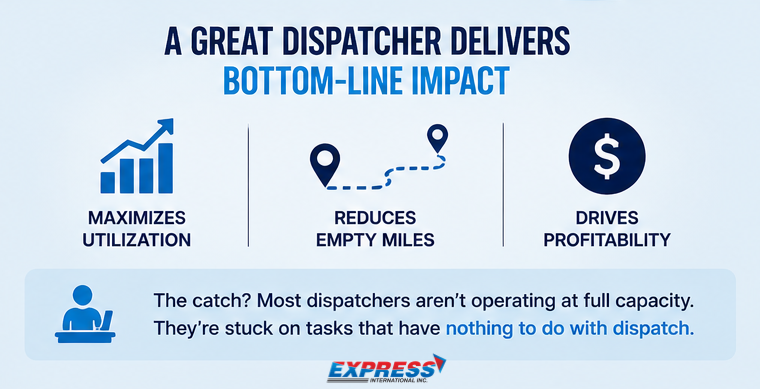
Driver shortages amplify their importance even further. The American Trucking Associations has warned of a deficit approaching 160,000 qualified drivers, meaning every truck on the road has to be utilized as efficiently as possible. Skilled dispatchers are the ones making that happen. A good dispatcher, operating at full capacity, contributes directly to the bottom line by maximizing utilization and cutting empty miles.
The catch? Most dispatchers aren’t operating at full capacity. They’re stuck on tasks that have nothing to do with dispatch.
2. The Paperwork That’s Stealing Their Time
Walk through a typical dispatcher’s day and you’ll find a surprising portion of it consumed by back-office work that has little to do with freight movement:
- Processing and updating driver applications in the Applicant Tracking System (ATS)
- Submitting compliance documentation: DOT crash reports, employment history verifications, criminal background checks
- Managing bills of lading, trip reports, and freight invoices
- Submitting documents to factoring companies for payment processing
- Completing broker credit checks and FMCSA filings
- Handling track-and-trace updates and data entry across TMS platforms
According to a 2024 industry analysis, dispatchers “often work round the clock to handle emergencies, queries, and scheduling changes.” The workload is relentless. But buried inside that workload are hours of administrative tasks that, while essential for compliance and cash flow, require accuracy and attention, not dispatch expertise.
This is the critical distinction most fleet operators miss. Not all of a dispatcher’s time is equally valuable. The hours spent on load sourcing, driver communication, and rate negotiation? Irreplaceable. The hours spent manually entering data, chasing documentation, and filing compliance records? Those can, and should, be handled elsewhere.
3. What Happens When Dispatch Spends Less Time Dispatching
Here’s where it gets expensive.
The average U.S. dispatcher earns roughly $54,000 per year. Benefits, equipment, and software subscriptions add another 20–30% on top of that, bringing the true cost closer to $65,000–$70,000 annually per dispatcher. If a meaningful portion of that employee’s day is absorbed by administrative processing, you’re paying a premium-tier operations professional to do work that doesn’t require their expertise.
The hidden cost compounds quickly across a fleet:
- Delayed load coverage. When dispatchers are tied up with paperwork, drivers wait. Empty miles accumulate. Revenue leaks.
- Compliance risk. Rushed documentation creates errors. Errors create audit exposure. FMCSA violations carry fines and, in serious cases, operational disruptions.
- Burnout and turnover. Dispatching is already a high-stress role. Layering administrative overload onto it accelerates burnout, and dispatcher turnover brings its own replacement costs.
- Growth ceiling. When your dispatch team is at capacity, adding volume means adding headcount. That costs time, money, and management bandwidth you may not have during a market uptick.
The math is straightforward. Every hour a dispatcher spends on paperwork is an hour not spent on moves that generate revenue. At freight’s current recovery pace, that gap will only grow more costly.
4. How Leading Fleets Are Already Solving This
The answer isn’t hiring more dispatchers. It’s removing the administrative burden from the ones you have.
Forward-thinking carriers have started separating operational work from back-office processing, assigning the former to their dispatch teams and the latter to dedicated support specialists who handle the documentation pipeline.
We’ve seen this model work firsthand. One of New Mexico’s largest trucking companies, operating over 1,600 vehicles, 1,900 drivers, and routes across all 48 continental states, faced exactly this challenge as their hiring volume increased. Rather than expanding their internal team, they turned to Express International, who was already providing their offshore recruiters.
The result: their in-house recruiters shifted entirely to driver engagement and relationship-building. The administrative pipeline (applications, compliance checks, background verifications, FMCSA documentation) moved to Express International’s trained back-office team. Processing costs dropped by nearly 50%.
Their in-house team didn’t shrink. It sharpened. And the work that used to create friction now runs in the background, handled by specialists who do it all day, every day.
(Read the full case study: Maximizing ROI: The Smart Move to Offshore Recruitment Processing)
5. Why Express International Is Different
There’s no shortage of BPO providers willing to take your money. There are very few who understand trucking well enough to step in without a six-month ramp-up.
Express International is different for a specific reason: we know this industry.
Our teams in Georgetown, Guyana support U.S. trucking and logistics companies with services built around transportation workflows, not generic back-office templates. That includes:
- Track and trace and dispatch assistance
- Driver onboarding and FMCSA compliance documentation
- Recruitment processing and application management
- Data entry, analytics, and operational reporting
- Invoicing support and factoring submissions
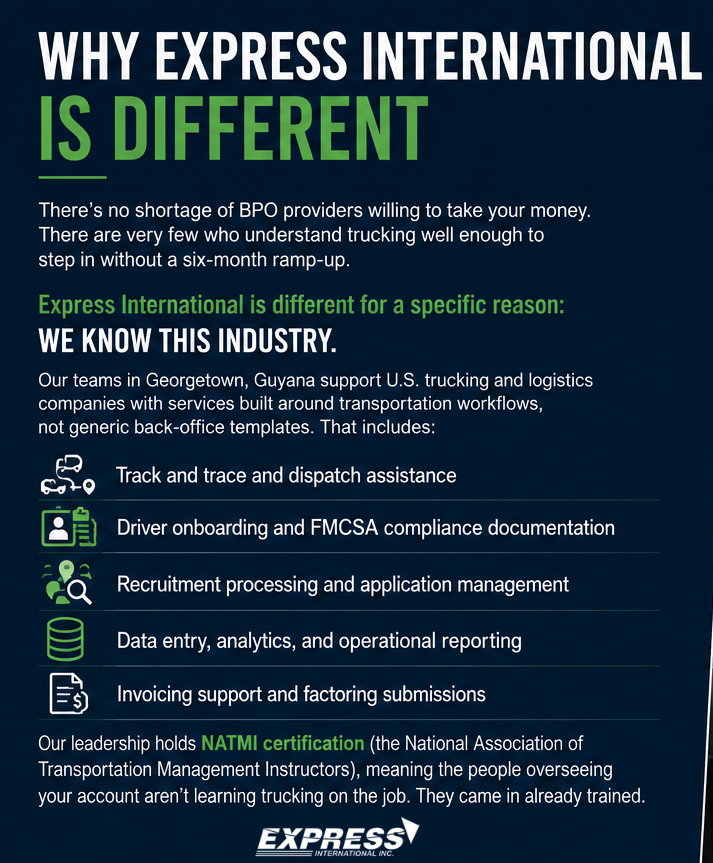
Our leadership holds NATMI certification (the National Association of Transportation Management Instructors), meaning the people overseeing your account aren’t learning trucking on the job. They came in already trained.
We’re also OA500 recognized, ranking among the top 500 BPO providers globally, with clients who have stayed with us for multiple years and refer others. When one of our U.S. fleet partners processed over 750,000 data entries in a single year (a milestone that had never been reached before), their operations team put it plainly: “It’s really a lot, and we can’t thank you enough.”
That kind of volume is what happens when your dispatch team focuses on dispatch, and your back-office work is handled by people built for exactly that.
And because we’re nearshore, operating in the same time zone as the U.S. East Coast, in English, with deep cultural alignment to North American business standards, the integration doesn’t feel like outsourcing. It feels like an extension of your team.
(Learn more about our nearshore model: Nearshore Outsourcing in Guyana: What U.S. Logistics Leaders Should Know)
The Strategic Takeaway
Freight is recovering. That’s good news. But recovery rewards the prepared.
Fleets that head into the next growth cycle with lean, focused operations, dispatch teams doing what dispatchers do best, and back-office work running efficiently in the background, will scale faster, carry less overhead, and absorb volume without the chaos that comes from scrambling to hire.
The goal isn’t to replace your people. It’s to stop asking them to do two jobs at once.
If your dispatchers are spending hours a day on paperwork, that’s not a staffing problem. It’s a structure problem. And it has a straightforward fix.
Ready to Free Up Your Dispatch Team?
Express International helps U.S. trucking companies separate administrative load from operational expertise, without adding headcount or disrupting your existing workflows.
Schedule a free consultation today and find out how our nearshore teams in Guyana can take the paperwork off your dispatchers’ plates, so they can get back to what moves freight.
About Express International
Express International Inc. is a performance-driven BPO company registered in both Guyana and the USA. We specialize in providing high-value business solutions including analytics, customer service, back-office support, and specialized industry services at a fraction of traditional costs.
Our analytics team combines advanced technical skills with business acumen to deliver insights that transform how our partners make decisions, allocate resources, and drive growth.