

At a Glance
- FMCSA launched Motus: the USDOT Registration System on May 19, 2026, replacing the legacy Unified Registration System and several other disconnected platforms.
- The goal is centralization, stronger identity verification, and fraud prevention. DOT estimated several thousand suspicious registration numbers were tied to fraudulent carriers under the old setup.
- The transition has been bumpy. FMCSA temporarily suspended USDOT inactivations in June and issued fraud alerts in August after scammers began impersonating Motus.
- Motus is a technology upgrade. Managing it is still a people-and-process problem.
- The carriers adapting fastest are the ones with clear ownership, documented workflows, and enough administrative capacity to absorb change without pulling Safety and Operations off higher-value work.
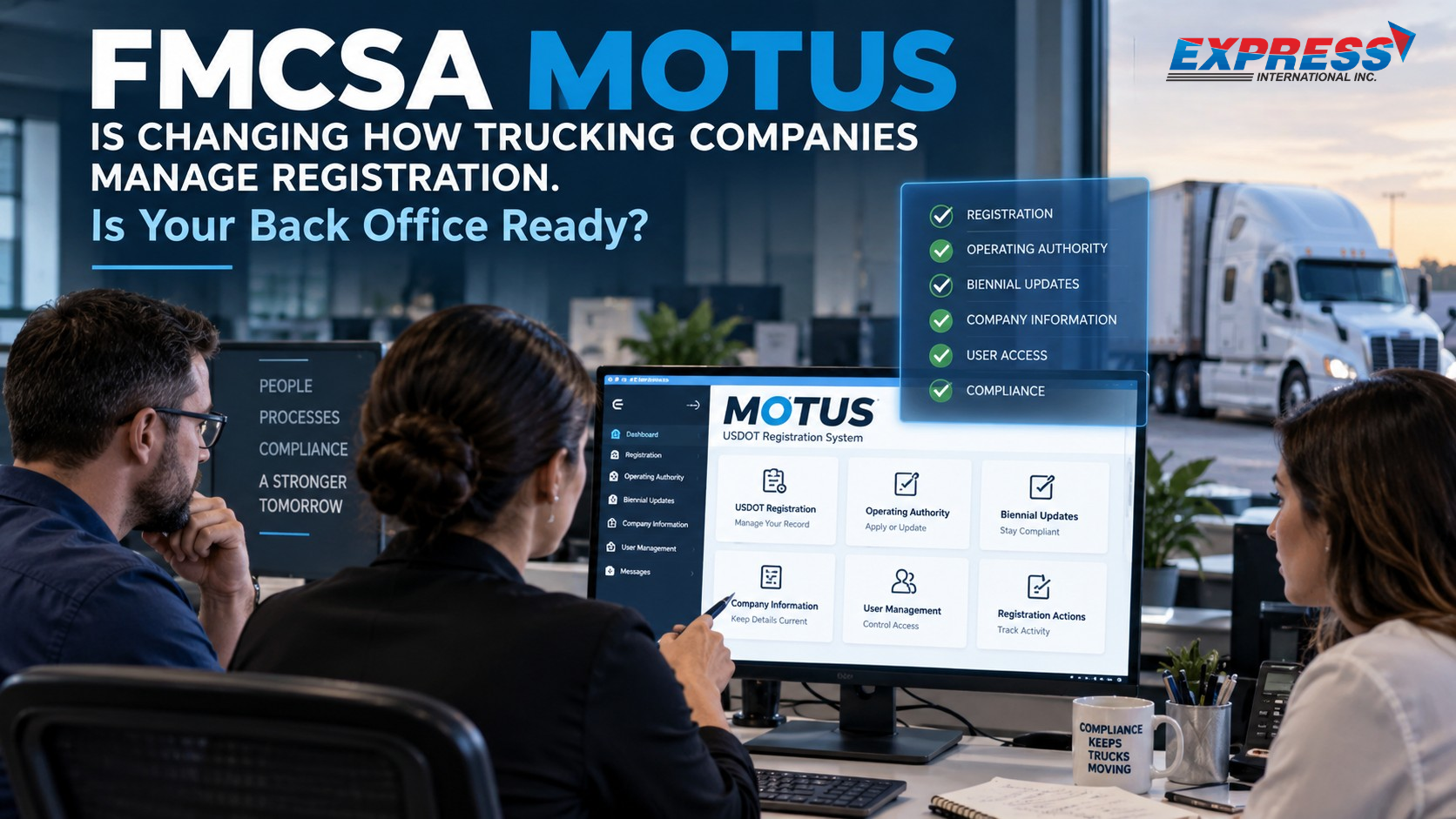
FMCSA registration just went through one of its biggest changes in decades.
On May 19, 2026, the Federal Motor Carrier Safety Administration launched Motus: the USDOT Registration System, replacing a network of legacy systems that motor carriers, brokers, and freight forwarders had used for years. The legacy Unified Registration System was sunset on May 14.
The goal is ambitious. One centralized, more secure environment for managing federal registration, with stronger identity verification, better data accuracy, and real fraud prevention built into the front door.
And the fraud problem is real. When announcing Motus, the U.S. Department of Transportation estimated that several thousand suspicious registration numbers were tied to fraudulent carriers under the old system.
That alone makes modernization necessary.
But for legitimate trucking companies, there is another side to this transition. Someone still has to claim the company’s USDOT record. Someone has to manage access, verify information, track biennial updates, organize supporting documentation, monitor FMCSA notices, resolve discrepancies, and follow up when something does not work.
Motus may be a technology upgrade. Managing it is still a people-and-process problem.
For trucking companies already asking Safety, Compliance, and Operations teams to do more with fewer resources, that distinction matters more than the software does.
1. What Actually Changed With FMCSA Motus?
For years, FMCSA registration functions were scattered across multiple systems. Registration data lived in one place, licensing and insurance in another, and carrier information somewhere else entirely. Motus is designed to close those gaps.
The new USDOT Registration System provides a single environment for activities including:
- Applying for a USDOT Number
- Applying for operating authority
- Completing biennial updates
- Updating company information
- Requesting additional operating authority
- Reinstating suspended authority
- Reactivating or inactivating USDOT Numbers
- Managing users and company access
- Tracking registration actions
Existing carriers do not receive new USDOT or docket numbers simply because of the transition. Access is what changed.
| Legacy System | Motus | |
| Access method | USDOT PIN | Login.gov with identity verification |
| Identity checks | Name, email, physical address | Government-issued ID, facial verification, third-party business validation |
| Where registration lives | Spread across five or six applications | One centralized dashboard |
| Account control | Loosely managed | Role-based access assigned by the company official |
| Data validation | Largely after the fact | Validated in real time |
That last row matters more than it looks. Real-time validation means errors surface immediately instead of six weeks later in a notice nobody opens.
Source: Federal Motor Carrier Safety Administration, Registration Modernization resources, 2026.
2. Why FMCSA Made Fraud the Priority
Motus is not a website redesign.
According to FMCSA, the legacy registration environment gave bad actors room to hide their identities, manipulate registrations, and operate under someone else’s carrier information. Chameleon carriers, reincarnated carriers, and shell companies all exploited the same weakness: a system that asked for very little proof that an applicant was who they claimed to be.
The safeguards introduced with Motus include enhanced identity verification, biometric checks, data analytics, and randomized USDOT and operating authority docket numbers for new registrations.
Why does that matter to a legitimate fleet?
Because carrier fraud does not stop at the fraudulent company. Identity theft, double brokering, compromised USDOT numbers, and fraudulent registrations create downstream risk for carriers, brokers, shippers, insurers, and customers across the entire freight ecosystem. If you have ever spent a week untangling a load someone booked using your MC number, you already know the cost is not theoretical.
So Motus is solving a genuine industry problem.
But stronger controls also raise the bar internally. Tighter federal identity requirements mean your company needs tighter answers to a few questions of its own: who can access registration information, who is authorized to make changes, and how company credentials are protected.
3. The Rollout Has Not Been Seamless
Here is where Motus stops being an IT story.
On June 22, 2026, FMCSA announced it had temporarily suspended the inactivation of USDOT Numbers for entities that had not completed required biennial updates since June 1.
The agency said the measure was intended to reduce disruption while it continued supporting the transition, and specifically advised registrants not to worry about inactivation resulting from Motus-related access or system issues while recovery and stabilization efforts continued.
That is a significant admission. The agency responsible for the system recognized that transition issues were substantial enough to warrant temporarily changing how a registration consequence was applied.
FMCSA has since published troubleshooting resources for companies struggling to claim USDOT records and established support channels for Motus issues.
For carriers, the takeaway is not that Motus is failing. It is that major regulatory technology changes generate administrative work even when your company has done absolutely nothing wrong.
When something does not update correctly, someone has to catch it. When access fails, someone has to escalate it. When FMCSA publishes new instructions, someone has to read them. And when an issue stays unresolved, someone has to keep following up until it is not.
None of that is glamorous work. All of it has to happen.
4. There Is Already Another Risk: Fake Motus Sites and Scams
The transition also created an opening for scammers.
In August 2026, FMCSA updated its Fraud Alerts page with a warning that bad actors had begun impersonating the Motus application itself. Carriers reported receiving official-looking emails directing them to bogus Motus portals, often with urgent language about setting up an account or fixing a supposed error in the registration process.
These scams work precisely because the real process sounds similar. Motus genuinely does require carriers to verify their identity and connect their account to an existing USDOT record. Fraudsters simply mirror that language.
A second variation has surfaced as well: third parties charging carriers a fee, in some reported cases around $200, for registration access that FMCSA provides for free. Only the carrier can complete the identity verification. Third parties have to be granted access by the carrier inside the portal.
Now think about what that means operationally.
If five different employees receive regulatory emails and no one owns the decision about which are legitimate, your exposure is not a technology gap. It is a process gap.
- Who receives regulatory communications?
- Who verifies them?
- Who holds access to company registration accounts?
- Who approves changes?
- Who documents what was completed, and when?
Those questions should have one answer each. Not five.
5. The Real Motus Challenge Is Administrative Capacity
This is where trucking companies should look past the technology.
A registration task sounds simple on paper. In practice the workflow looks more like this:
Monitor → Gather → Verify → Route → Complete → Track → Escalate → Document
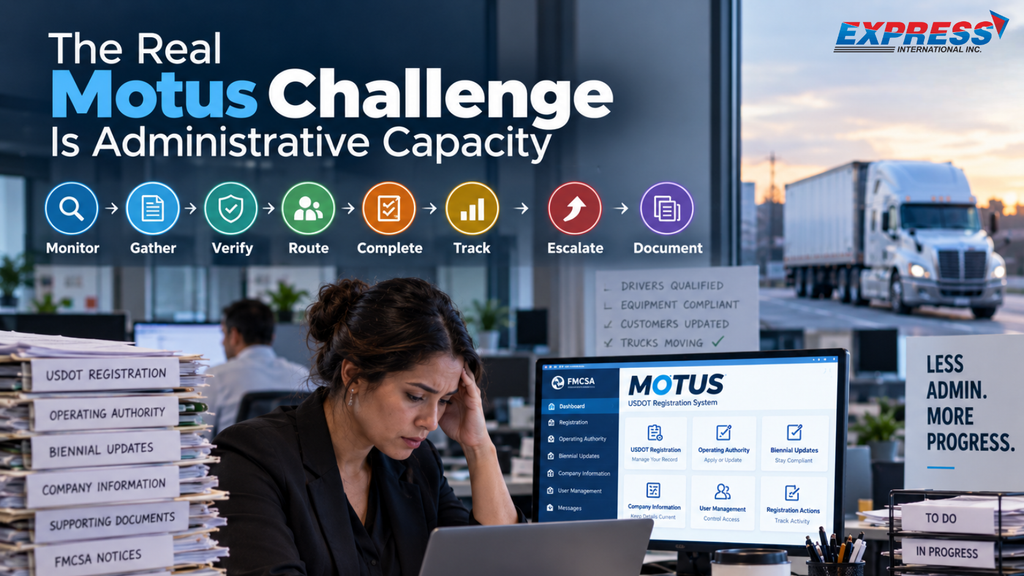
Every step takes time. And the people absorbing that time are usually the same people responsible for keeping drivers qualified, equipment compliant, customers updated, incidents handled, records current, and trucks moving.
That creates a familiar problem. Your highest-value employees start spending their day on administrative work.
We have written about this pattern before in trucking operations. Dispatchers become data-entry specialists. Recruiters spend hours chasing documents. Safety personnel become spreadsheet managers. Operations teams move information between systems instead of managing the exceptions that actually need their expertise.
Motus did not create that problem. It exposed it.
If one new federal system creates meaningful disruption inside your operation, the issue may not be the system. It may be that your back-office processes were already running too close to capacity to absorb anything new.
6. Is Your Company Motus-Ready? A Six-Point Self-Audit
You do not need a transformation project to answer this. Start with the basics.
Account and Access
- Has your company successfully claimed its USDOT record in Motus?
- Is the correct company official responsible for the account?
- Are authorized users clearly identified?
- Does each person have only the access their role requires?
Registration
- Is your company information accurate?
- Do you know when your next biennial update is due?
- Is someone actively monitoring registration and authority status?
- Are outstanding actions being tracked somewhere other than an inbox?
Documentation
- Can your team quickly retrieve documents needed to support an update?
- Are records maintained in one centralized location?
- Is there documentation showing when required actions were completed?
Escalation
- What happens when a Motus transaction cannot be completed?
- Who submits the support ticket?
- Who follows up?
- Who decides when an issue needs internal escalation?
Security
- Do employees know what legitimate Motus communications look like?
- Are links verified before anyone provides company information?
- Are the people responsible for registration aware of current FMCSA fraud alerts?
Change Management
- Who monitors FMCSA for new Motus guidance?
- How are changes communicated across the organization?
- Who updates internal procedures when FMCSA changes the process?
If those questions produce five different answers from five different employees, that gap is worth closing before the next regulatory change arrives.
7. Which of This Work Actually Needs Your Safety Team?
This may be the more valuable question.
Regulatory accountability belongs with the carrier, and any activity requiring qualified compliance judgment should stay with the appropriate personnel. That is not negotiable.
But not every task surrounding compliance requires that level of expertise.
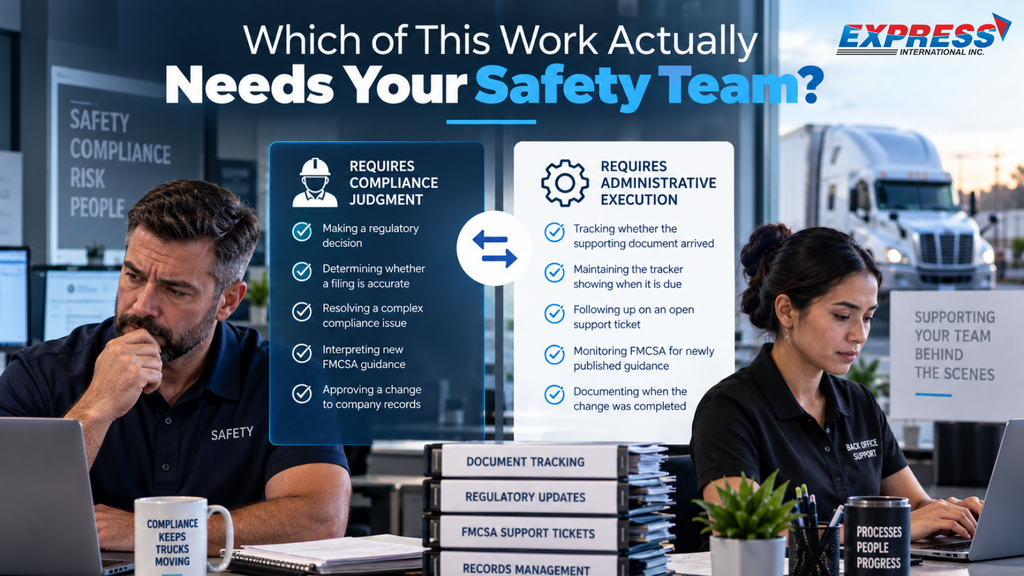
| Requires compliance judgment | Requires administrative execution |
| Making a regulatory decision | Tracking whether the supporting document arrived |
| Determining whether a filing is accurate | Maintaining the tracker showing when it is due |
| Resolving a complex compliance issue | Following up on an open support ticket |
| Interpreting new FMCSA guidance | Monitoring FMCSA for newly published guidance |
| Approving a change to company records | Documenting when the change was completed |
Those are two different kinds of work with two different skill requirements and two very different costs.
Yet many trucking companies assign all of it to the same people.
That is where a structured back-office model starts to make sense.
8. Where BPO Support Fits Without Outsourcing Accountability
A BPO partner should never replace your Safety or Compliance leadership. And outsourcing administrative work does not transfer the carrier’s regulatory responsibility to anyone else. It cannot, and any partner suggesting otherwise is one to walk away from.
The real opportunity is more practical.
A trained transportation support team can handle the repeatable administrative workflows around compliance while your qualified personnel retain decision-making authority. Depending on your requirements and internal controls, that could include:
- Maintaining internal compliance trackers
- Monitoring deadlines and biennial update schedules
- Organizing and centralizing documentation
- Reviewing records for completeness
- Coordinating document requests
- Tracking outstanding registration actions
- Maintaining escalation logs
- Following up on unresolved administrative items
- Updating internal SOPs and checklists
- Monitoring published FMCSA guidance
- Preparing operational and management reports
Think of it as separating administrative execution from compliance judgment.
That separation gives experienced Safety and Operations personnel their time back for the work that actually requires what they know.
9. What Happens When That Work Is Separated
This is not theoretical for us.
Express International supports U.S. transportation companies with back-office functions ranging from driver and recruitment processing to data management, reporting, track and trace, and other transportation operations workflows.
In one trucking operation we support, administrative processing was separated from work being handled by higher-cost internal personnel.
Processing costs fell by nearly 50%.
The internal team did not become less important. It became more focused.
We have seen the same principle hold in other regulated environments. In a five-year engagement with a U.S. consumer reporting agency, structured nearshore support delivered $16.7 million in savings while accuracy and turnaround improved rather than slipped.
Our teams work North American hours from Georgetown, Guyana, the only English-speaking country in South America, under COPC-trained and certified leadership. Express International is also recognized among the OA500, the annual index of the top 500 BPO providers globally, and we maintain 90%+ CSAT across the accounts we support.
That combination is the point. Cultural alignment and time zone overlap are what make a nearshore team feel like part of your operation instead of a handoff.
Key Benefits at a Glance
| Challenge Motus creates | What structured back-office support delivers |
| New administrative workload with no new headcount | Dedicated trained capacity without internal hiring |
| Unclear ownership of registration tasks | Documented workflows with named owners at each step |
| Deadlines tracked informally or in inboxes | Centralized trackers with active monitoring and escalation |
| Safety staff pulled into clerical work | Specialized personnel refocused on compliance judgment |
| Guidance changes going unnoticed | Ongoing monitoring of published FMCSA updates |
| High cost per administrative transaction | Processing costs reduced by up to half |
The Strategic Takeaway
Motus is here. Over time, a centralized, fraud-resistant registration system should genuinely benefit legitimate carriers.
But the early transition offers a bigger lesson.
Compliance infrastructure is not just software. It is people. Processes. Documentation. Ownership. Escalation. Quality control. And enough administrative capacity to make sure required work still gets done when the system, the regulation, or the process changes underneath you.
FMCSA will keep refining Motus. New guidance will come. The process will become familiar.
The carriers best positioned to adapt will be the ones that know exactly who owns each step, and have enough support around their Safety and Operations teams to execute those steps consistently.
Because the question is not only whether your company understands Motus.
It is whether your operation is built to keep up with whatever comes next.
Frequently Asked Questions
What is FMCSA Motus? Motus is the U.S. Department of Transportation’s centralized USDOT Registration System, launched May 19, 2026. It replaced the legacy Unified Registration System and other disconnected platforms, consolidating registration applications, biennial updates, operating authority requests, and account management into one environment with stronger identity verification.
Do existing carriers get a new USDOT number under Motus? No. Existing carriers keep their USDOT and docket numbers. What changed is access. Carriers must claim their USDOT record in Motus using Login.gov and complete identity verification, replacing the previous reliance on USDOT PINs.
Who should claim the company account in Motus? FMCSA expects the initial claim to be made by the company official using the same Login.gov email associated with the prior FMCSA Portal account. If the wrong person attempts the claim, it can create delays and access problems that take time to resolve.
Does Motus cost anything to use? No. Registration through Motus is free. Any third party charging a fee for basic Motus access or registration should be treated with caution. Only the carrier can complete identity verification, and third parties must be granted access by the carrier inside the portal.
Can a BPO partner handle FMCSA compliance for my company? A BPO partner cannot assume your regulatory accountability, and no reputable partner will claim to. What a trained transportation support team can do is handle the administrative workflows around compliance: tracking deadlines, organizing documentation, monitoring guidance, maintaining escalation logs, and following up on open items, while your qualified personnel retain all decision-making authority.
Is Administrative Work Pulling Your Transportation Team Away From Higher-Value Work?
Express International helps U.S. trucking and logistics companies build dedicated nearshore support around transportation operations, back-office processing, documentation, reporting, and other repeatable workflows.
Our role is not to replace your internal expertise. It is to give that expertise the operational support it needs to stay focused.
Explore our Transportation Operations Support or start with our Risk-Free BPO Pilot Program and see what a dedicated nearshore team looks like inside your operation before you commit to anything.
Prefer to talk it through first? Get a free quote.
About Express International
Express International Inc. is a performance-driven BPO company registered in Guyana and the United States. We provide business solutions across transportation operations, back-office processing, customer service, talent acquisition, finance and accounting, and real-time analytics and business intelligence.
Our transportation-focused teams support U.S. companies with structured processes designed around the realities of trucking and logistics operations.
Disclaimer: This article is provided for general informational purposes only and does not constitute legal or regulatory advice. Motor carriers should rely on current FMCSA guidance and qualified professionals when determining their specific registration and compliance obligations.