
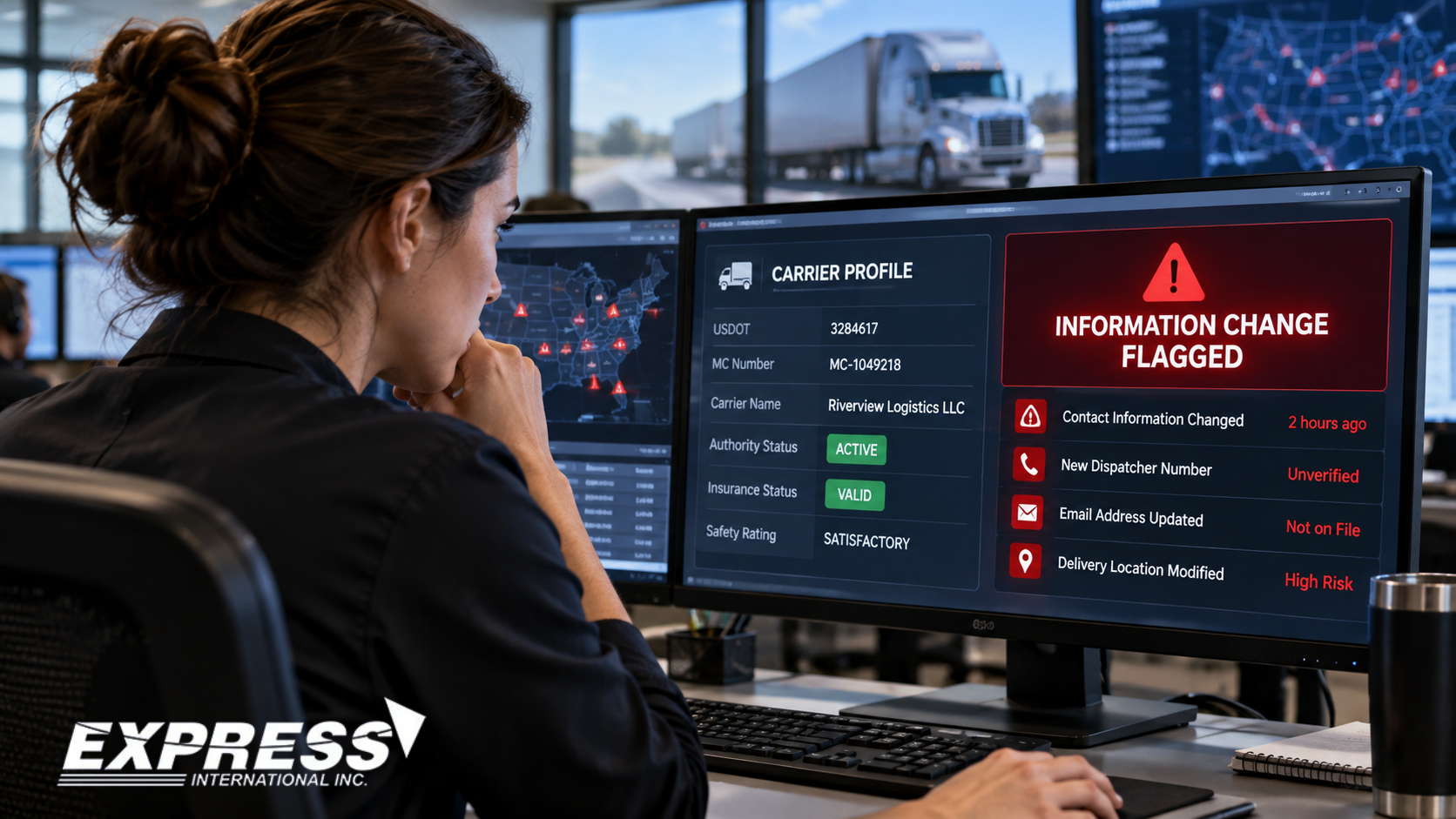

Cargo theft losses hit $725 million in 2025, and fraud is now the fastest-growing method. Here is where it enters your operation, and the five controls worth auditing.
| At a Glance |
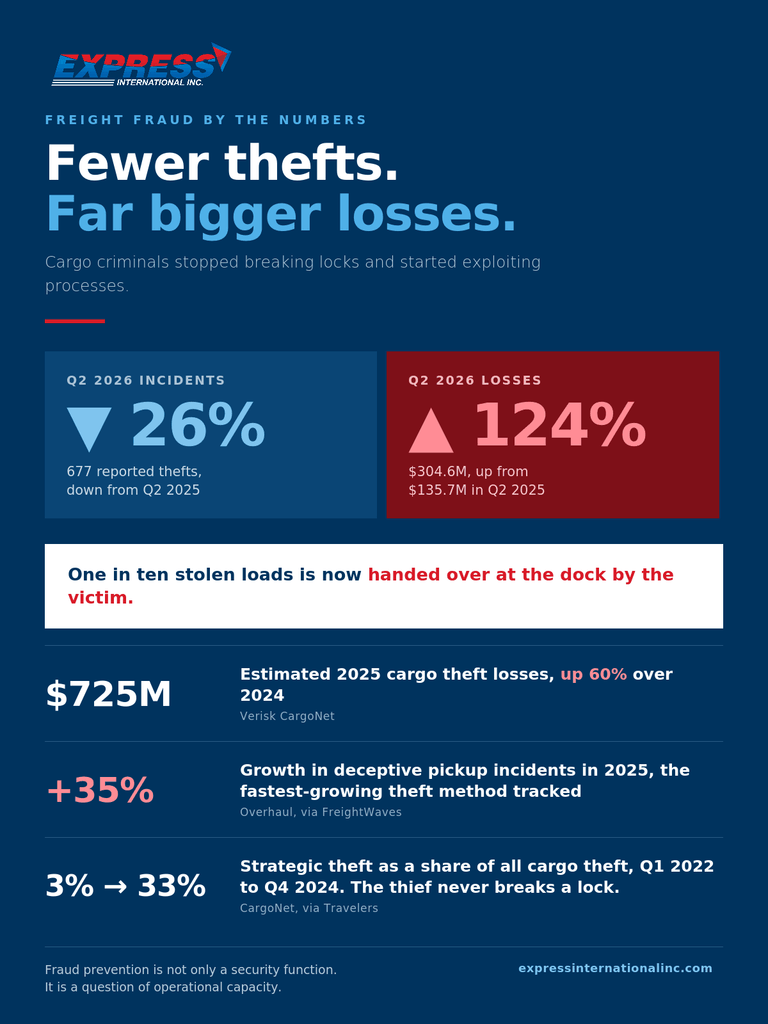
- Cargo theft losses across the U.S. and Canada reached an estimated $725 million in 2025, a 60% increase over 2024, according to Verisk CargoNet.
- Q2 2026 losses hit $304.6 million, roughly 124% above the $135.7 million recorded in Q2 2025, even though reported incidents fell 26%.
- Fewer incidents, far higher losses. Criminals are being more selective, and a single successful fraud now carries far more financial weight.
- Deceptive pickup, where a criminal poses as a legitimate carrier, rose 35% in 2025 and is the fastest-growing theft method Overhaul tracks.
- Strategic theft, the kind where nobody breaks a lock, grew from roughly 3% of all cargo theft to about 33% between early 2022 and late 2024.
- Technology and regulation are both improving. Neither closes the gap if no one inside your operation owns verification, monitoring, and escalation.
1. Freight Fraud Is Changing, and the Math Is Getting Worse
A shipment is booked with what appears to be a legitimate carrier. The paperwork looks correct, the registration is active, and the pickup is scheduled. Everything moves according to plan.
Then something shifts. A dispatcher calls from an unfamiliar number. A driver requests a different delivery location. An email arrives with revised instructions. Someone updates the carrier’s contact information.
Individually, any one of those is routine. The question is what happens when they are not.
According to Verisk CargoNet’s 2025 annual analysis, estimated cargo theft losses across the United States and Canada reached nearly $725 million in 2025, a 60% increase over 2024. The same report found:
- 2,646 confirmed cargo theft incidents, up 18% from 2,243
- $273,990 average theft value, up 36% from $202,364
- Food and beverage thefts up 47%, the largest increase of any category
- Metal theft up 77%, driven largely by copper demand
Read those together and the story is not that theft is more frequent. Total supply chain crime events were essentially flat, 3,594 in 2025 against 3,607 in 2024. What changed is that criminal organizations got better at choosing what to steal.
The 2026 Numbers Make the Point Sharper
CargoNet’s second-quarter 2026 data found estimated losses of $304.6 million, against $135.7 million in Q2 2025. That is roughly a 124% increase.
Reported incidents over the same period fell 26%, down to 677. Average reported commodity value climbed to $564,009.
So the volume went down and the damage more than doubled.
For carriers, brokers, and logistics providers, that inverts the usual assumption. Fewer incidents do not mean lower exposure. When organized groups concentrate on high-value freight and sophisticated deception, one successful incident can do what a dozen opportunistic thefts used to.
Which means the problem is no longer mainly about protecting physical freight. It is about protecting the processes, information, and communications that determine who gets handed that freight in the first place.
2. The Threat Is Often Not Someone Stealing a Truck
Traditional cargo theft meant physical access. A trailer disappears from a truck stop. A shipment walks out of a warehouse. Unattended equipment gets targeted.
Those threats have not gone anywhere. But the growth is somewhere else entirely.
Between the first quarter of 2022 and the fourth quarter of 2024, strategic theft, where the criminal never breaks a lock, grew from roughly 3% of all cargo theft to about 33%, according to CargoNet data cited by Travelers. One in three.
Three patterns matter most.
Carrier Identity Theft
A criminal impersonates a legitimate motor carrier using its USDOT number, operating authority, or company name, then books freight or communicates with brokers while appearing to represent an established company.
| CargoNet also flagged something worth sitting with: many of the more complex schemes rely on acquiring existing motor carriers with strong load histories. The authority is real. The compliance record is real. The people operating it are not who you think. |
Fraudulent and Deceptive Pickups
Rather than stealing a shipment, criminals use deceptive credentials to be handed one. A warehouse releases cargo to someone who appears authorized, and by the time the discrepancy surfaces, the freight is gone.
Overhaul’s 2025 analysis, reported by FreightWaves, found deceptive pickup incidents rose 35% year over year, now representing about 10% of recorded U.S. cargo theft events. It is the fastest-growing method the firm tracks. The trend carried into 2026, with deceptive pickup schemes up 31% in Q1 and accounting for 11% of reported U.S. activity in Q2. In Southern California specifically, deceptive pickup climbed from 24% to 28% of local cases.
One in ten stolen loads is now handed over at the dock by the victim.
Compromised Communications
A fraudulent email, an impersonated dispatcher, or an unauthorized change to shipment instructions can redirect freight or expose sensitive business information. These are hard to catch precisely because they look like ordinary operational traffic.
CargoNet logged 158 fictitious pickup reports in Q2 2026 alone, out of 677 total theft reports, and identified business email compromise as the primary entry point for the more sophisticated schemes.
The lesson is uncomfortable but simple. A shipment can be compromised without anyone touching a truck. The vulnerability usually starts with a piece of information nobody independently verified.
3. Where Freight Fraud Enters Everyday Operations
Transportation runs on constant communication. Dispatchers coordinate drivers. Brokers verify carriers. Customer service manages updates. Accounting processes payments. Operations absorbs changes all day long.
Every one of those interactions is a point where information gets received, reviewed, and acted on. Which makes every one of them a point where a fraudulent instruction can enter the workflow.
Five situations worth testing against your own operation:
A carrier requests a contact information change. Is it verified against independently established contact details, or does someone just update the record?
A driver provides revised delivery instructions. Does anyone confirm the change with the authorized customer or broker first?
Tracking information stops updating. Does someone investigate promptly, or does it sit until the customer calls?
An email requests a banking information change. Is there a documented verification process, or does it depend on who opens the email?
A carrier’s documentation looks inconsistent. Does anyone own identifying and escalating that?
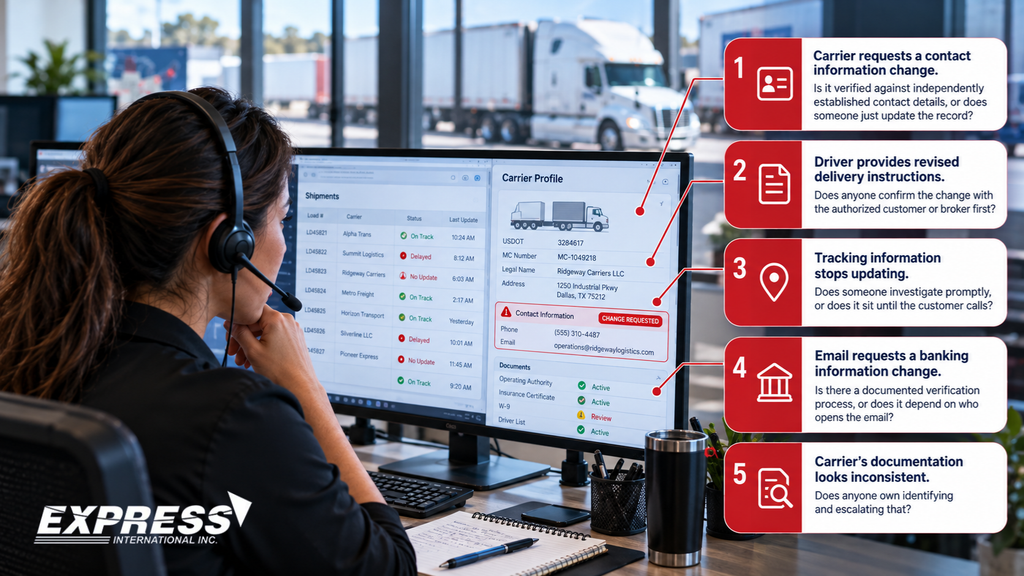
These are not hypotheticals. FMCSA specifically recommends independently verifying carrier and broker telephone numbers, examining supporting documentation, and confirming vehicle and driver information when something seems off.
The safeguards exist. The hard part is applying them consistently on a Tuesday afternoon when three other things are on fire.
The Cost of an Overloaded Back Office
Picture a dispatcher coordinating shipments while also answering customer inquiries, updating records, chasing missing documents, monitoring tracking exceptions, managing driver communications, and reviewing carrier information changes.
Every one of those tasks matters. Not every one requires that dispatcher’s specialized expertise.
When administrative work consumes most of the day, there is less room left to investigate the thing that looked slightly wrong. That does not mean an overloaded back office causes fraud. It means operational capacity determines how reliably a company can apply the safeguards it already has.
| Fraud prevention depends on knowing what to check. It also depends on having the time, the process, and the accountability to actually check it. |
4. Technology Is Necessary. It Is Not Sufficient.
Fraud prevention technology has improved considerably. Carrier monitoring platforms, identity verification systems, shipment visibility tools, and automated alerting all help surface suspicious activity.
What none of them do is guarantee that a warning gets the right response.
A system flags a mismatch in carrier information. Someone still has to investigate it. A tracking platform catches an unexpected route deviation. Someone still has to decide whether it is legitimate and whether to escalate. A document system identifies missing information. Someone still has to follow up, validate the response, and record the outcome.
This is the same argument we made in Why AI Alone Won’t Fix Trucking Operations: automation works best when it sits on top of people who can manage exceptions, communicate clearly, and close issues out.
The goal is not to replace technology with manual process. It is to build an operating model where the two reinforce each other instead of each assuming the other is handling it.
5. FMCSA Is Tightening Controls. What Happens Inside Your Company?
Fraud prevention is getting regulatory attention too.
In May 2026, FMCSA launched Motus, its new USDOT Registration System, with stronger identity verification intended to reduce fraudulent registrations. The agency estimated that several thousand suspicious registration numbers were tied to fraudulent carriers under the previous environment.
That is a meaningful step. It does not eliminate the need for internal verification, for two reasons.
First, a carrier can hold a completely legitimate registration and still have its identity stolen. A valid company record does not confirm that the person claiming to represent that company is authorized to.
Second, regulators get impersonated too. On January 30, 2026, FMCSA issued an alert about an aggressive phishing campaign using emails that falsely claimed to come from USDOT or FMCSA officials, complete with professional-looking documents and plausible links. The agency noted that official correspondence almost always comes from a .gov address, that it will never request Social Security numbers, bank details, or payment through unsolicited messages, and that carriers should verify through official channels rather than trusting the apparent sender.
By August, scammers had moved on to impersonating the Motus portal itself.
Our Motus article made the same underlying point: stronger external systems still require someone inside the company to own the administrative work around them. Someone maintains accurate records. Someone verifies communications. Someone monitors discrepancies. Someone follows up on incomplete information. And someone knows when to escalate to qualified personnel.
Freight fraud prevention runs on exactly the same discipline.
6. Five Operational Controls Worth Reviewing
No process eliminates freight fraud. But companies can reduce avoidable exposure by examining how information gets verified, monitored, and escalated across the shipment lifecycle.
1. Define Carrier Verification Beyond “Does the Number Exist”
Checking that a USDOT or MC number is active is a starting point, not a verification procedure. Build steps for reviewing carrier information, confirming authorized contacts, identifying inconsistencies, and escalating suspicious changes. FMCSA recommends verifying contact information through SAFER and independently confirming details when discrepancies appear.
Verification should trigger at defined points, particularly whenever information changes.
2. Turn Track and Trace Into Exception Management
Location updates alone are not monitoring. Define which events warrant attention:
- Unexpected tracking interruptions
- Unexplained route deviations
- Changes to pickup or delivery instructions
- Unusual delays or communication gaps
- Conflicting information from different shipment contacts
Most exceptions are not fraud. A structured process is what lets you tell the difference quickly.
3. Standardize Document Handling
Incomplete or fraudulent documentation creates real exposure. Review how carrier packets, insurance certificates, bills of lading, and delivery records are received and maintained.
Administrative teams can check completeness, organize records, and flag discrepancies. Decisions requiring compliance expertise, authorization, or fraud investigation stay with qualified personnel.
4. Make Escalation Explicit
The most important question in any operational process is what happens when something does not look right. Employees should know which discrepancies require escalation, who is authorized to investigate or approve changes, how suspicious activity gets documented, when a shipment or transaction goes on hold, and who communicates with affected parties.
Ambiguity here is how a genuine red flag gets processed as routine admin.
5. Test Your After-Hours Coverage
Freight moves overnight, on weekends, and across time zones. Fraud does not keep business hours.
A tracking exception identified at 2:00 a.m. should not sit untouched until morning. The point is not having someone watching a screen. It is making sure time-sensitive information reaches an authorized decision-maker while it still matters.
7. Which Fraud Prevention Tasks Actually Need Your Internal Experts?
This may be the most useful question a transportation executive can ask.
Fraud prevention requires qualified judgment and clear authority. But not every supporting activity needs a senior dispatcher, safety manager, or operations executive.
| Requires qualified internal judgment | Can be supported through structured administrative workflows |
| Approving a carrier relationship | Collecting and organizing carrier documentation |
| Investigating suspected identity theft | Flagging discrepancies for review |
| Authorizing changes to shipment instructions | Recording changes and routing verification requests |
| Making fraud-related risk decisions | Maintaining exception and escalation logs |
| Approving banking information changes | Tracking requests and confirming approvals are documented |
| Determining the response to suspicious activity | Monitoring tracking exceptions and notifying authorized personnel |
| Establishing fraud prevention policy | Maintaining workflow documentation and operational reporting |
The left column is risk management. The right column is execution capacity.
Companies do not need to outsource anything in the left column to get more of the right. Separating the two is what lets internal experts concentrate where their judgment creates value, and it is usually what makes the procedures they wrote get followed consistently.
8. Where a Transportation-Focused BPO Partner Fits
As fraud grows more sophisticated, the practical question is whether your operational teams have the capacity to maintain the controls you have already established.
For some companies the answer is better internal workflow. For others it is technology, training, or additional administrative support.
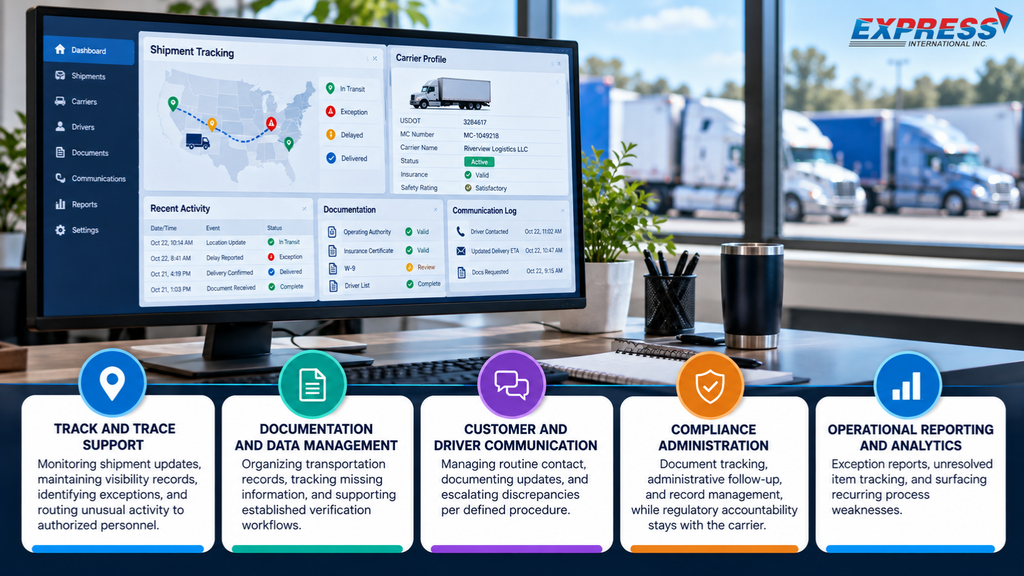
A transportation-focused BPO partner addresses the last of those without taking ownership of fraud investigations or regulatory decisions. At Express International, our work with U.S. transportation and logistics companies centers on the processes that keep information moving accurately:
- Track and trace support — monitoring shipment updates, maintaining visibility records, identifying exceptions, routing unusual activity to authorized personnel
- Documentation and data management — organizing transportation records, tracking missing information, supporting established verification workflows
- Customer and driver communication — managing routine contact, documenting updates, escalating discrepancies per defined procedure
- Compliance administration — document tracking, administrative follow-up, record management, while regulatory accountability stays with the carrier
- Operational reporting and analytics — exception reports, unresolved item tracking, surfacing recurring process weaknesses
The value is not that an outside team becomes responsible for preventing fraud. It is that the safeguards you already built get the administrative follow-through they need to work.
| In one trucking operation we support, separating administrative execution from work handled by higher-cost internal personnel cut processing costs by nearly 50%. The internal team did not become less important. It became more focused, with more room for the exceptions that actually needed judgment. |
Our teams work North American hours from Georgetown, Guyana, under COPC-trained and certified leadership, which matters for the after-hours coverage question in section 6. Express International is also recognized among the OA500 index of the top 500 BPO providers globally, and we maintain 90%+ CSAT across the accounts we support.
9. The Real Question: Can Your Operation See the Warning Signs?
Freight fraud is not going to recede because software improves or registration systems get more secure. Tactics will keep evolving, and the data suggests they are evolving toward deception rather than force.
The response has to be more than another platform or another verification requirement. It means looking honestly at how your existing safeguards perform on an ordinary day:
- Are carrier information changes independently verified?
- Are shipment exceptions investigated promptly?
- Do employees know when to escalate?
- Are verification and approval responsibilities clearly assigned?
- Do those procedures hold during peak volume and outside business hours?
Those questions tend to surface weaknesses that technology alone will not fix.
The companies best positioned are the ones combining effective tools, qualified people, documented procedure, and enough operational capacity to execute all three consistently.
In an industry where one compromised shipment can represent half a million dollars in exposure, catching the warning signs is not a security function. It is an operational one.
Frequently Asked Questions
What is freight fraud?
Freight fraud covers schemes where criminals use deception rather than force to obtain or divert shipments. Common forms include carrier identity theft, deceptive or fictitious pickups, double brokering, and business email compromise used to alter shipment or payment instructions. Unlike traditional cargo theft, freight fraud typically exploits legitimate business processes rather than physical security gaps.
How much is cargo theft costing the industry?
Verisk CargoNet estimated nearly $725 million in losses across the U.S. and Canada in 2025, a 60% increase over 2024, across 2,646 confirmed thefts averaging $273,990 each. Q2 2026 losses reached $304.6 million, roughly 124% above the same quarter in 2025, even though reported incident counts fell.
What is a deceptive pickup?
A deceptive pickup is when a criminal poses as a legitimate carrier or broker, using stolen load information or falsified credentials, and is voluntarily handed the freight at a shipper facility or warehouse. Overhaul reported these rose 35% in 2025 and now account for roughly one in ten recorded cargo theft events.
Does an active USDOT number mean a carrier is legitimate?
Not on its own. A registration can be valid while the party using it is not authorized, either through identity theft or because the authority itself was acquired by a criminal operation. CargoNet has noted that complex schemes frequently rely on purchasing existing carriers with strong load histories. Independent verification of contacts and documentation remains necessary.
Can a BPO partner handle fraud prevention for my company?
No reputable partner will claim to. Fraud investigation, risk decisions, and policy ownership stay with your qualified personnel. What a transportation-focused support team can do is maintain the administrative execution around those controls: monitoring exceptions, organizing documentation, flagging discrepancies, maintaining escalation logs, and ensuring follow-up happens.
Is Your Back Office Supporting Your Risk Management Efforts?
Transportation companies cannot eliminate every fraud risk. They can strengthen the processes that identify discrepancies, maintain accurate information, and make sure exceptions get timely attention.
Express International supports U.S. trucking and logistics companies with dedicated nearshore teams specializing in transportation operations, track and trace, documentation, customer service, compliance administration, and reporting.
Our role is not to replace your security, safety, or compliance professionals. It is to provide the operational support that lets those professionals stay focused on the decisions that need their expertise.
Start with our Risk-Free BPO Pilot Program or request a consultation to discuss how structured nearshore support could strengthen your transportation operations.
| Related reading: FMCSA Motus Is Changing How Trucking Companies Manage Registration, and our free 31-point Motus Readiness Checklist. |
About Express International
Express International Inc. is a performance-driven BPO company registered in Guyana and the United States, recognized among the OA500 index of leading global BPO providers. We support U.S. and international organizations across transportation, logistics, customer service, talent acquisition, finance and accounting, and business intelligence.
With extensive experience supporting U.S. trucking operations, Express International provides dedicated teams designed to improve operational efficiency, strengthen administrative execution, and allow clients to focus on their core business priorities.
Disclaimer: This article is provided for general informational purposes and does not constitute legal, cybersecurity, insurance, or regulatory advice. Transportation companies should consult qualified professionals when establishing fraud prevention, security, and compliance procedures.